Showing posts with label ads. Show all posts

Friday, 4 January 2008

Optimise the ads on your blog

When working with a blog, you are facing some interesting ad implementation challenges: a predetermined page format, highly targeted content and regular visitors, among other things. To make the most of your readership and content, here are a few suggestions:


Blend ads into your blog


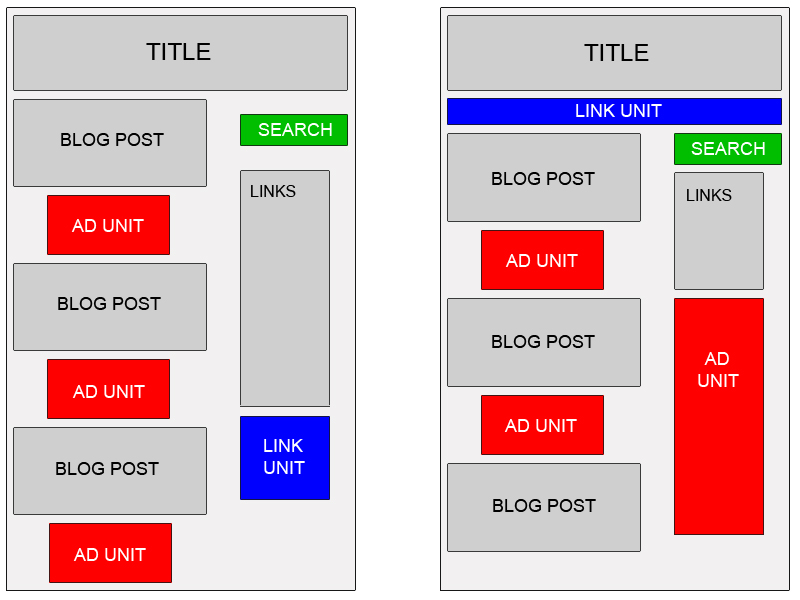
To increase the likelihood that your readers will see and click on your ads, blend your ad units into the background of your blog. Choose a bold colour for the ad title to help draw attention to your ads then make sure that the background and borders of your ads are the same colour as the background of the area where the ad is placed.

Map

Experiment with multiple ad formats and locations


In general, wider ad formats tend to be more reader-friendly. Placing an ad unit after the first post will likely catch your readers' attention. Take a look at our sample implementations to get some ideas. In addition, consider placing a Skyscraper (120x600) or vertical link unit on the right side of your blog. If you are using Blogger, you can find instructions on placing AdSense code in your blog's sidebar.


Offer readers more options with search and referrals


To make sure that you are earning the most revenue possible with AdSense, go beyond just ads to use AdSense for search and referrals. You can increase your earnings, provide readers with valuable information and take advantage of flexible formats.


Improve ad targeting


With section targeting, you can target an ad unit to a specific section of your blog, as well as block out irrelevant sections like navigational links. We recommend that only those familiar with HTML attempt to implement section targeting.


Tip for generating more traffic to your blog: If you are a Blogger user, activate this setting to notify Weblogs.com, a blog update notification service, whenever you have updated your blog. That means that your blog will be included in various "recently updated" lists on the web as well as other blog-related services.

Monday, 31 December 2007

Google Adsense in Blogger, and inline too

I have an article telling how to insert Google ad in blogger's post which involvels template change and my transform module. I have just discovered that there's a much more easy way to do this. What a pity I haven't seen it comming sooner.

Here's all you need to do:
  1. Log into your Blogger account at http://www.blogger.com .
  2. Visit your blog's Template tab and click on the Page Elements link.
  3. Click Edit in the Blog Posts section.


  4. Check the box next to Show Ads Between Posts. You can then select how often you'd like your ads to appear, such as once after every post or once after every other post.


  5. Customize the ads and click on Save Changes when you're done.
Please note that right now, it's only possible to insert Google ads using this widget, and not AdSense for search boxes or referral units.

For more detailed instructions, please visit Blogger's Help Center. Lastly, don't forget to check out our blog optimization tips for ways to improve your ad performance.

Easy huh? Link to this post to let your friends know. Happy new year! :)

Friday, 28 December 2007

Researcher Critiques Payday Lending Ban

A ban on payday loans may be leading to greater financial burdens for low-income residents of two Southern states, according to a researcher at the Federal Reserve Bank of New York.

The study concluded that "compared with households in all other states, households in Georgia have bounced more checks, complained more to the Federal Trade Commission about lenders and debt collectors, and filed for Chapter 7 bankruptcy protection at a higher rate."

North Carolina households have fared about the same, said the report, written by Donald P. Morgan, a research officer with the Federal Reserve Bank of New York, and Cornell University graduate student Michael R. Strain.

"This negative correlation _ reduced payday credit supply, increased credit problems _ contradicts the debt trap critique of payday lending," the report concluded.

Payday lenders offer quick cash advances _ for a fee _ that customers are supposed to repay with their next paycheck. Borrowers who cannot repay the loan often "roll over" the loan repeatedly, a cycle that critics of payday loans call the debt trap. Borrowers are drawn to the lenders because, unlike banks and credit unions, they don't run credit checks.

Georgia banned payday lending in May 2004. North Carolina has gone back and forth with payday lenders.

In 1997, the state began allowing payday loans. The law expired in 2001, and many small payday lenders closed, but the largest lending chains linked up with out-of-state banks to keep offering the loans. A banking commissioner's ruling in 2005, followed soon after by a consent agreement between three payday lenders and Attorney General Roy Cooper, essentially shuttered the industry's doors in the state.

"The thing is with payday lending, the business model itself is dependent on the debt trap," said Uriah King, a researcher at the Center for Responsible Lending in Durham. "They couldn't open up their doors if they couldn't put short-term borrowers into long-term debt."

King criticized the report because it drew on data from the Federal Reserve's check cashing centers in Atlanta and Charlotte, which processes tranactions in states other than Georgia and North Carolina, including those that do allow payday loans.

Last month, a report by the University of North Carolina Center for Community Capital prepared for the North Carolina Commissioner of Banks concluded "the absence of storefront payday lending has had no significant impact on the availability of credit for households in North Carolina."

That study was criticized by Community Financial Services Association of America, a trade group that represents 60 percent of the industry, because it included survey response data from people who had never sought a payday loan.

"Households without access to payday loans are forced to use costlier credit and suffer greater financial difficulties," said CFSA president Darrin Andersen.

And while payday lending may not be the correct choice "all the time" for consumers, "it's certainly a smart choice from the alternatives," Andersen said.

May be after the recent incidents, they know that they should be careful...
Showing posts with label ads. Show all posts

Friday, 4 January 2008

Optimise the ads on your blog

When working with a blog, you are facing some interesting ad implementation challenges: a predetermined page format, highly targeted content and regular visitors, among other things. To make the most of your readership and content, here are a few suggestions:


Blend ads into your blog


To increase the likelihood that your readers will see and click on your ads, blend your ad units into the background of your blog. Choose a bold colour for the ad title to help draw attention to your ads then make sure that the background and borders of your ads are the same colour as the background of the area where the ad is placed.


Map

Experiment with multiple ad formats and locations


In general, wider ad formats tend to be more reader-friendly. Placing an ad unit after the first post will likely catch your readers' attention. Take a look at our sample implementations to get some ideas. In addition, consider placing a Skyscraper (120x600) or vertical link unit on the right side of your blog. If you are using Blogger, you can find instructions on placing AdSense code in your blog's sidebar.


Offer readers more options with search and referrals


To make sure that you are earning the most revenue possible with AdSense, go beyond just ads to use AdSense for search and referrals. You can increase your earnings, provide readers with valuable information and take advantage of flexible formats.


Improve ad targeting


With section targeting, you can target an ad unit to a specific section of your blog, as well as block out irrelevant sections like navigational links. We recommend that only those familiar with HTML attempt to implement section targeting.


Tip for generating more traffic to your blog: If you are a Blogger user, activate this setting to notify Weblogs.com, a blog update notification service, whenever you have updated your blog. That means that your blog will be included in various "recently updated" lists on the web as well as other blog-related services.

Monday, 31 December 2007

Google Adsense in Blogger, and inline too

I have an article telling how to insert Google ad in blogger's post which involvels template change and my transform module. I have just discovered that there's a much more easy way to do this. What a pity I haven't seen it comming sooner.

Here's all you need to do:
  1. Log into your Blogger account at http://www.blogger.com .
  2. Visit your blog's Template tab and click on the Page Elements link.
  3. Click Edit in the Blog Posts section.


  4. Check the box next to Show Ads Between Posts. You can then select how often you'd like your ads to appear, such as once after every post or once after every other post.


  5. Customize the ads and click on Save Changes when you're done.
Please note that right now, it's only possible to insert Google ads using this widget, and not AdSense for search boxes or referral units.

For more detailed instructions, please visit Blogger's Help Center. Lastly, don't forget to check out our blog optimization tips for ways to improve your ad performance.

Easy huh? Link to this post to let your friends know. Happy new year! :)

Friday, 28 December 2007

Researcher Critiques Payday Lending Ban

A ban on payday loans may be leading to greater financial burdens for low-income residents of two Southern states, according to a researcher at the Federal Reserve Bank of New York.

The study concluded that "compared with households in all other states, households in Georgia have bounced more checks, complained more to the Federal Trade Commission about lenders and debt collectors, and filed for Chapter 7 bankruptcy protection at a higher rate."

North Carolina households have fared about the same, said the report, written by Donald P. Morgan, a research officer with the Federal Reserve Bank of New York, and Cornell University graduate student Michael R. Strain.

"This negative correlation _ reduced payday credit supply, increased credit problems _ contradicts the debt trap critique of payday lending," the report concluded.

Payday lenders offer quick cash advances _ for a fee _ that customers are supposed to repay with their next paycheck. Borrowers who cannot repay the loan often "roll over" the loan repeatedly, a cycle that critics of payday loans call the debt trap. Borrowers are drawn to the lenders because, unlike banks and credit unions, they don't run credit checks.

Georgia banned payday lending in May 2004. North Carolina has gone back and forth with payday lenders.

In 1997, the state began allowing payday loans. The law expired in 2001, and many small payday lenders closed, but the largest lending chains linked up with out-of-state banks to keep offering the loans. A banking commissioner's ruling in 2005, followed soon after by a consent agreement between three payday lenders and Attorney General Roy Cooper, essentially shuttered the industry's doors in the state.

"The thing is with payday lending, the business model itself is dependent on the debt trap," said Uriah King, a researcher at the Center for Responsible Lending in Durham. "They couldn't open up their doors if they couldn't put short-term borrowers into long-term debt."

King criticized the report because it drew on data from the Federal Reserve's check cashing centers in Atlanta and Charlotte, which processes tranactions in states other than Georgia and North Carolina, including those that do allow payday loans.

Last month, a report by the University of North Carolina Center for Community Capital prepared for the North Carolina Commissioner of Banks concluded "the absence of storefront payday lending has had no significant impact on the availability of credit for households in North Carolina."

That study was criticized by Community Financial Services Association of America, a trade group that represents 60 percent of the industry, because it included survey response data from people who had never sought a payday loan.

"Households without access to payday loans are forced to use costlier credit and suffer greater financial difficulties," said CFSA president Darrin Andersen.

And while payday lending may not be the correct choice "all the time" for consumers, "it's certainly a smart choice from the alternatives," Andersen said.

May be after the recent incidents, they know that they should be careful...

Money making search

Google Custom Search